
Bridging Micro-Climate Data with Crop-Specific Advisory: A New Era of IoT-Driven Agronomy
Introduction
Agriculture is no longer about managing a field — it’s about managing a living ecosystem. Every crop responds differently to micro-climatic conditions such as temperature, humidity, and radiation. Yet, most advisory systems still rely on regional weather forecasts or manual field observations, leaving farmers to make broad decisions in highly variable conditions.
With the integration of IoT-enabled micro-climate sensing and crop-specific data intelligence, the new era of agronomy is here — one where farmers can act on localized, real-time, and crop-tailored insights rather than general assumptions.
The Micro-Climate Gap in Traditional Farming
Even within a single farm, micro-climatic conditions can vary drastically. A patch under shade nets might be 3°C cooler and 15% more humid than an open section. Such subtle variations influence:
- Flowering and fruit-set efficiency
- Disease outbreak likelihood
- Nutrient absorption and transpiration
- Pest activity cycles
Conventional weather data can’t capture these minute differences, which often decide the success or failure of a crop.
This is where IoT-based micro-climate sensing networks like mClimateSense® come in — providing farmers with real-time, hyperlocal environmental intelligence.
Turning Data into Actionable Advisory
Capturing climate data is only half the story. The real transformation happens when this data is interpreted through crop models.
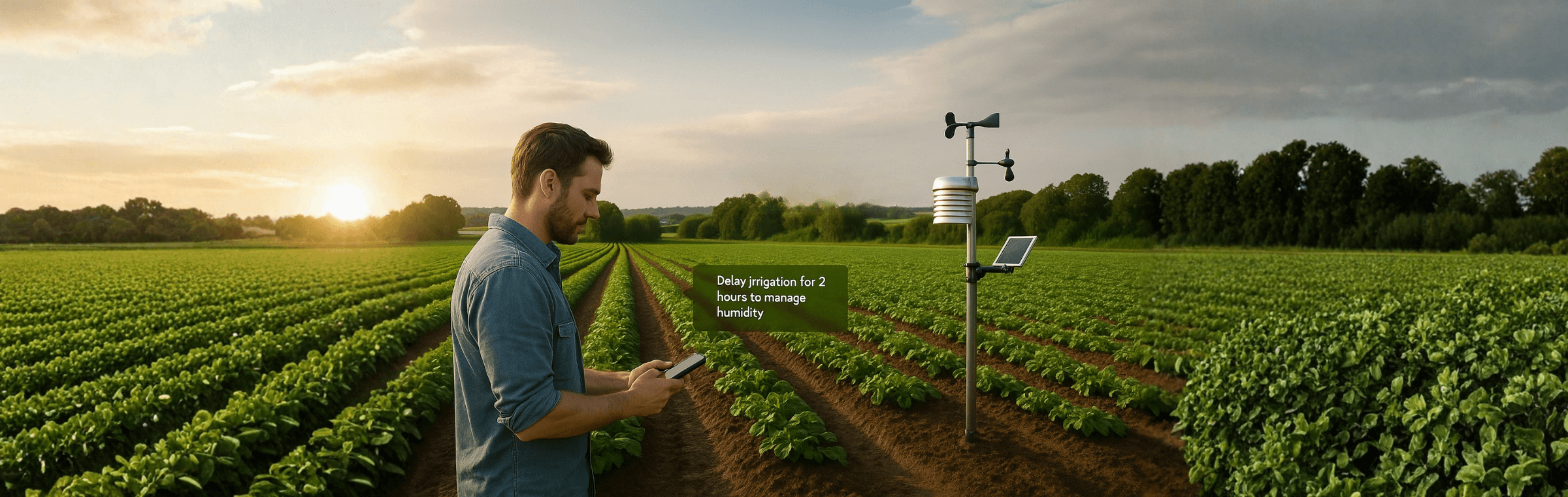
By combining micro-climate sensor inputs (temperature, humidity, PAR, CO₂, and pressure) with crop physiology models and AI-based analytics, farmers can receive targeted advisory such as:
- “Delay irrigation for 2 hours — current humidity levels are sufficient.”
- “Increase ventilation — CO₂ levels exceed optimal range for tomato flowering.”
- “Spray window optimal: low wind speed and adequate radiation forecasted.”
These advisories are no longer generic recommendations; they are crop-specific and condition-driven, tailored to each farm’s micro-climate and phenological stage.
The Science Behind Smart Advisory
IoT-driven advisory systems leverage three key data pillars:
- Sensor Data — from mClimateSense® nodes measuring temperature, humidity, PAR, CO₂, rainfall, and pressure.
- Predictive Data — from weather APIs integrated through thingZmate®, forecasting short-term climate patterns.
- Crop Knowledgebase — dynamic models that define optimal micro-climate thresholds for different growth stages (e.g., flowering, fruiting).
When these data streams converge, the system generates precise recommendations that optimize irrigation, nutrient application, and climate control actions.
Beyond Data — Building an Ecosystem of Decisions
The value of IoT in agriculture doesn’t stop at monitoring. It lies in creating a connected ecosystem where:
- Soil data (from soilCard®)
- Irrigation data (from irrigoSmart®)
- Climate data (from mClimateSense®)
- Forecast data
…all flow into one unified decision framework.
This ecosystem empowers thingZmate® to deliver predictive, cross-parameter advisory such as:
“Soil moisture optimal but humidity high — postpone irrigation to avoid fungal stress.”
That’s the true power of IoT-driven agronomy: data collaboration leading to intelligent, context-aware decisions.
Future Outlook: Adaptive and Carbon-Smart Farming
As IoT platforms evolve, micro-climate data will also power carbon-smart agriculture. With continuous environmental tracking, farms can record carbon savings from efficient water use, reduced chemical input, and lower energy consumption — paving the way for carbon credit verification.
In the near future, farmers will not only monitor conditions but also predict and monetise sustainability outcomes — from energy efficiency to emission reduction.
Conclusion
The integration of micro-climate data with crop-specific advisory marks a transformative step in agriculture. No longer dependent on intuition or regional forecasts, farmers can now make data-backed, site-specific, and crop-aware decisions that maximize productivity while preserving ecological balance.
With innovations like mClimateSense®, thingZmate®, and soilCard®, agriculture is steadily advancing toward a future where every farm becomes a smart, adaptive ecosystem — learning, responding, and thriving in harmony with nature.
Keep Exploring Our Blog Collection

© 2025, Enthu Technology Solutions India Pvt. Ltd. All Rights Reserved.